If you’ve ever tried to get a true black in tie dye — especially ice dye — you know the struggle. You mix what looks like a deep, rich black powder, apply it to your fabric, and then pull it out of the bag only to find… purple. Or navy. Or some murky gray that’s nowhere near what you wanted.
So I did what any reasonable person does: I tested 17 different blacks from Jacquard, Dharma, ProChemical, DyeSpin, Grateful Dyes, Tulip, and Rit, and I compared them all side by side. I tested each one two ways — dye over the ice (DOI) and dye under the ice (DUI) — because the method genuinely changes the result. Everything you see below comes directly from my swatches.

If you want to see the full visual comparison, I’ve got the video linked right here. But if you want the quick breakdown of which black tie dye is actually worth your money, keep reading.
Why Black Tie Dye Is So Hard to Get Right
Before we get into the results, it helps to understand why black is tricky. Most fiber reactive black dyes are not a single pigment — they’re a blend of colors (typically blues, reds, and purples) that combine to read as black on fabric. When you add ice to the equation, those component colors separate as the dye spreads, which is exactly why your “black” ice dye ends up looking purple or blue in certain spots.
This splitting can be beautiful and intentional — but if you want true black, you need a dye that’s formulated to stay cohesive even as it migrates through wet fabric.
The method also matters. I tested both dye over ice (DOI) and dye under ice (DUI) for every color in this test, and the results were often dramatically different. In most cases, DOI produced a stronger, more saturated result — so keep that in mind as you read.

If you’d like to WATCH this experiment check out this video here.
Ice Dye vs Liquid Dye
Ice dyeing with black is completely different than liquid dyeing. I did a whole post on how to dye with black liquid dye. But I made these two shirts so you could see how different the results really are. These were both done using Jacquard Jet Black.


The Results, Brand by Brand
Jacquard — Jet Black
This is the one people always recommend, and honestly? The reputation is deserved. Jet Black from Jacquard is one of the truest blacks I tested. It runs slightly blue, but it reads as black in the finished piece. The one thing to note is that wherever the ice sits, it creates a lighter area around it — the dye spreads away from where it’s concentrated. That’s not a flaw so much as just how this dye behaves, and once you know it, you can plan around it.

Verdict: My top pick for the truest black. Worth the higher price tag if black is a color you reach for often. Use code ANNA for 20% off at Jacquard.
Dharma Trading Co. — Raven, Better Black, and New Black
Dharma offers three blacks, and they are not created equal.
Raven is the clear winner here. It’s a pretty true black with just a slight red-and-blue split that reads as a hint of purple in some light — but it holds together really well and is consistently one of the darkest results I got. This is what I’ve been personally using, and this test confirmed why.
Better Black lives up to its name in regular tie dye, but in ice dye it goes quite purple. If you’re doing ice dye specifically, skip it.
New Black had an interesting quirk: the DOI swatch was significantly more saturated than the DUI swatch. The DOI spread more and covered more ground, while the DUI version was darker at the center but had a smaller color field. If you’re using New Black for ice dye, go DOI.

Verdict: Order Raven. Full stop. It’s one of the most accessible fiber reactive blacks on the market and it delivers.
ProChemical and Dye — Cotton Black, 629, 628, and 604
I’ll be honest: ProChem was the most disappointing brand overall for ice dye blacks.
Cotton Black was the strongest performer of the four. The DUI version was surprisingly light, but the DOI result was bold and came through with good saturation — you could see blues and purples in the spread, which tells me it would be the truest black if mixed in liquid form.
Black 629 split quite purple, so it’s not a reliable true black.
Black 628 split the most dramatically of all the ProChem options — it would be a fun splitting color but it’s not a go-to for black results.
Black 604 split heavily blue but was actually the strongest for DOI application of the bunch.

Verdict: If you’re ordering from ProChem, Cotton Black is your best bet, but I wouldn’t make the trip to ProChem specifically for black. Their blacks just aren’t their strong suit.
DyeSpin — Art Black, Epic Black, and Black Work
DyeSpin had the most interesting variety of all the brands I tested.
Art Black was genuinely surprising — it looks distinctly green as a powder. But when applied DUI, it was one of the truest blacks in the entire test. DOI it split a bit more, but it still held together as a pretty true black. If you’re a DyeSpin fan, this is your black.
Epic Black ran purple, especially DUI. The DOI version was better but still leaned purple.
Black Work was actually the darkest of the three DyeSpin options — if you want maximum depth and don’t care about a purple cast, this is a good pick. DUI it went quite purple though.

Verdict: Art Black for the truest result. Black Work if darkness is your priority over hue accuracy.
Grateful Dyes — Busted Black, Charcoal Black, Black 95, and Black 93
Grateful Dyes had some of my favorite results in the whole test, and also some surprises.
Busted Black is actually marketed as a splitting dye — they lean into the multicolor effect. And DUI, it does exactly that. But DOI? It was barely splitting at all and came out as a pretty true black. That’s the kind of thing you only learn by testing.
Charcoal Black was one of the most impressive results in the entire test. It’s right up there with Jacquard Jet Black in terms of trueness. The catch: it spreads a lot. More than almost any other black I tested. So if you use it, go heavy-handed with the dye and use less ice than you normally would to compensate for that spread.
Black 95 and Black 93 looked almost identical to each other — both went pretty purple. They’re not bad, they’re just not true black.

Verdict: Charcoal Black is the star here and a genuine alternative to Jacquard. Just know it spreads and plan accordingly.
Tulip (Bonus)
Tulip isn’t a fiber reactive dye, and that shows. I extracted the powder from a Tulip bottle and sprinkled it directly, and it split quite purple and blue. In liquid form, Tulip typically comes out gray rather than true black. Fine for a casual project, not the right tool if black is what you’re going for.

Rit (Bonus)
Rit is a stain, not a fiber reactive dye, which means it will fade over time and with washing. In this test it also did something none of the other dyes did — it split orange, with a reddish tint. Very strange and kind of cool, but clearly not in the running for best black tie dye. If you use Rit, know that it will gray out over time.

The Final Rankings: Best Black Tie Dye
Here’s how I’d rank your options:
1. Jacquard Jet Black — The truest black, most consistent, slightly blue. Worth the cost if you dye with black regularly. Use code ANNA for 20% off.
2. Dharma Raven — The most accessible fiber reactive black. Slightly purple in some light, but holds together beautifully and is easy to order. My everyday go-to.
3. Grateful Dyes Charcoal Black — A surprisingly strong performer. Spreads more than the others, so adjust your technique, but the color payoff is there. Great option if you want to support a smaller company.

Honorable mention: DyeSpin Art Black — Not quite as dark as the top three, but a really true black with a fun story (green powder! who knew).
Skip for black specifically: ProChemical’s black lineup, Tulip, and Rit.
Tips for Getting the Truest Black in Ice Dye
Even with the best dye, technique matters. Here’s what I’d recommend:
- Use dye over ice (DOI) in most cases. The DOI results were stronger and more saturated across almost every brand I tested.
- Go heavy on the dye. Black needs more saturation than other colors to read as truly black rather than dark blue or charcoal gray.
- Use less ice than you think. More ice means more spreading and splitting, which works against you when you want true black.
- Be patient with the rinse. Black dye takes significantly longer to rinse out than most colors — plan for that before you start.

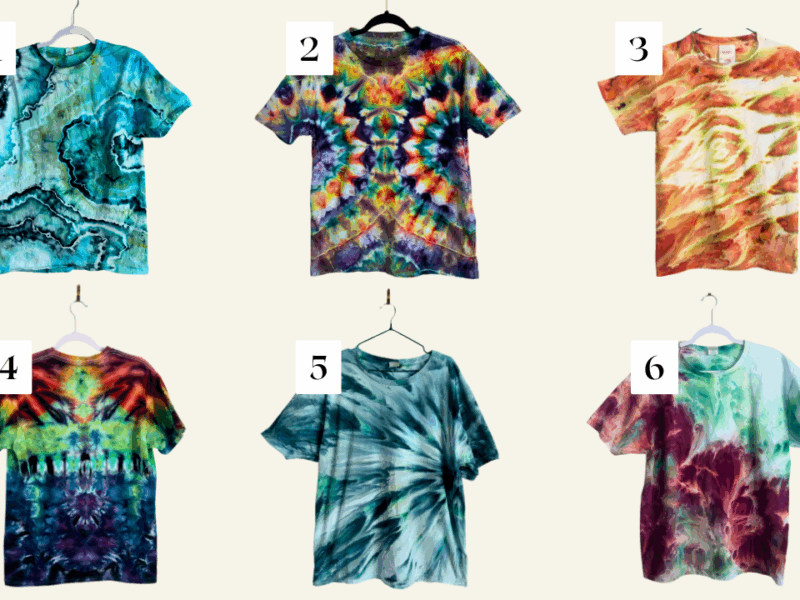
Want to see how I get a true black geode? I’ve got a full tutorial on that linked [here].
Shop the Dyes
Here are the links to the blacks I tested and recommend:
- Jacquard Jet Black — use code ANNA for 20% off at Jacquard.com
- Dharma Raven
- Grateful Dyes Charcoal Black
- DyeSpin Art Black
Have a black that you swear by that I didn’t test? Drop it in the comments — I have all of them now, so I’m ready to keep testing.
Thank you for doing the work for us!
I was pleased: I have Raven.
Raven is my favorite!